Lower Ark Hosted Arkansas River Basin Proposed Tabulation Update 2026
Barbara Crimond | Nov 01, 2026 | Comments 0

Submitted by Norman L. Kincaide, Ph.D.
Lower Arkansas Valley Water Conservancy District hosted, to a packed lobby, a presentation by State Water Engineer, Jason Ullmann and Division 2 Engineer, Rachel Zancanella, Colorado Division of Water Resources, October 29, 2026: Arkansas River Basin Proposed Tabulation Update 2026. This was the last of four meetings held in Division 2.
Ullmann provided a brief overview of the origins of Colorado water law. The Colorado Constitution, Article XVI, Section 5 and 6: “The water of every natural stream . . . is hereby declared to be the property of the public . . . subject to appropriation as herein provided.” “Priority appropriation shall give the better right as between those using the water for the same purpose.” This was established in 1876 as the beginning of Colorado water rights administration framework. In 1879 the Adjudication Act was passed that established water commissioners and ten water districts, Colorado being the first state to appoint local officials to physically manage and divide water resources. This was followed in 1881 with the Irrigation Act which promulgated a state water engineer. Colorado was the first state to create an executive office to administer private water use. In 1887 an Act was passed to create the Office of Superintendent of Irrigation and a Division Engineer. Further administration oversight was provided by the Water Rights Determination and Administration Act of 1969, (WRDA) which recognized the connection between ground and surface water and established Division water courts and augmentation plans.
The Division of Water Resources (DWR) directs the use of water according to statutes, court decrees, and other laws. This includes curtailing junior rights so that senior rights can divert, when there isn’t enough water to meet all needs. This precipitates water right postponement. A water right adjudicated in an earlier proceeding is senior to any water right adjudicated in a later proceeding, regardless of the date of appropriation, announced in Huerfano v. Hinderlider, 1927. Such rights are “postponed” and have a junior priority to the water. An example of water user A and B illustrated this system. Water user A had an appropriation date of 1898 with an original adjudication of 1907 (priority=1898 Senior. Water user B had an appropriation date of 1887, adjudicated in 1911, supplemental adjudication postponed, (priority=1907 + junior).
Four exceptions to the postponement doctrine were listed: Fischer v. Kuiper, 1974: continuing original adjudications through multiple years was quite common until the Huerfano v. Hinderlider decision, 1908 decree superseding 1892 and 1902 decrees in North Platte Basin. Luis Copa & Son v. Kuiper, 1970: upholding SEO decision that 1891 Las Animas County adjudication of the Apishapa River priorities is a continuation of 1887 Bent County adjudication. Home Supply v. Berthoud, 1995: upholding supplemental 1916 adjudication of Berthoud domestic right as senior priority as against an 1883 irrigation decree. And S Adams County Water & Sanitation District v. Broe Land Company, 1991: upholding state administration of 70 years treating North Fork of South Platte 1913 adjudication as original, not supplemental to 1883 South Fork South Platte decree.
There is a numbering system for priorities. “The division engineer . . . is responsible for maintaining a tabulation of all decreed water rights and conditional water rights in their respective division. This tabulation describes each water right, sets forth its priority and amount, and is based on court decrees.” 37-92-401(1)(a), Colorado Revised Statutes (CRS).
Tabulation is an administrative tool as Section 37-92-401(11) CRS describes: “Tabulations do not modify any terms of a decree or adjudication, no presumption of accuracy or validity.” Nothing in the tabulation “shall ever be construed to have enhanced or diminished any cause of action or defense which might otherwise exist concerning the administration of water rights in any water division.”
The division engineer is directed to use a suitable numbering system to order the priority of rights. DWR assigns an Admin number (aka Holt number) to each right, where the smaller number is senior to a larger number. A postponed water right is assigned a larger number based on the court adjudication dates, not just the date of first use or appropriation date. Tabulation should not change the priority that a right enjoyed for at least 18 years of historic practice (but no right is entitled to be more senior than the appropriation date). 37-92-401(1)(b)(VI), CRS.
The Administration number (Holt number) accounts for postponement for “supplemental” rights. The DWR Admin number indicates priority including postponement due to a later court adjudication. A smaller number reflects priority. An example of original adjudications where no previous adjudication date exists: Lower Boulder Ditch: adjudication date: June 2, 1882; previous adjudication date: none; Appropriation date: October 1, 1859=Admin number: 3561.00000. Supplemental adjudications where a previous adjudication exists with an appropriation date later than the previous adjudication date: Beaver Brook Pipeline: adjudication date: May 13, 1936; previous adjudication date: October 9, 1895; appropriation date: October 1, 1917=Admin number: 24745.00000. Supplemental adjudications where an appropriation date exists earlier than the previous adjudication date: Barnes Meadow Reservoir: adjudication date: December 18, 1945; previous adjudication date: April 22, 1922; appropriation date: July 22, 1921=Admin number: 26409.26135 (the first number reflects the previous adjudication date, the second reflects the appropriation date).
Tabulation must consider historic administration reflected in the “18 Year Statute” as an exception to postponement. Section 37-92-401(1)(b)(VI) CRS: “If applying postponement would cause a substantial change in the priority of a water right to the extent the right was lawfully enjoyed for a period of not less than eighteen years, then the division engineer SHALL designate the priority for that right in accordance with historic practice.”
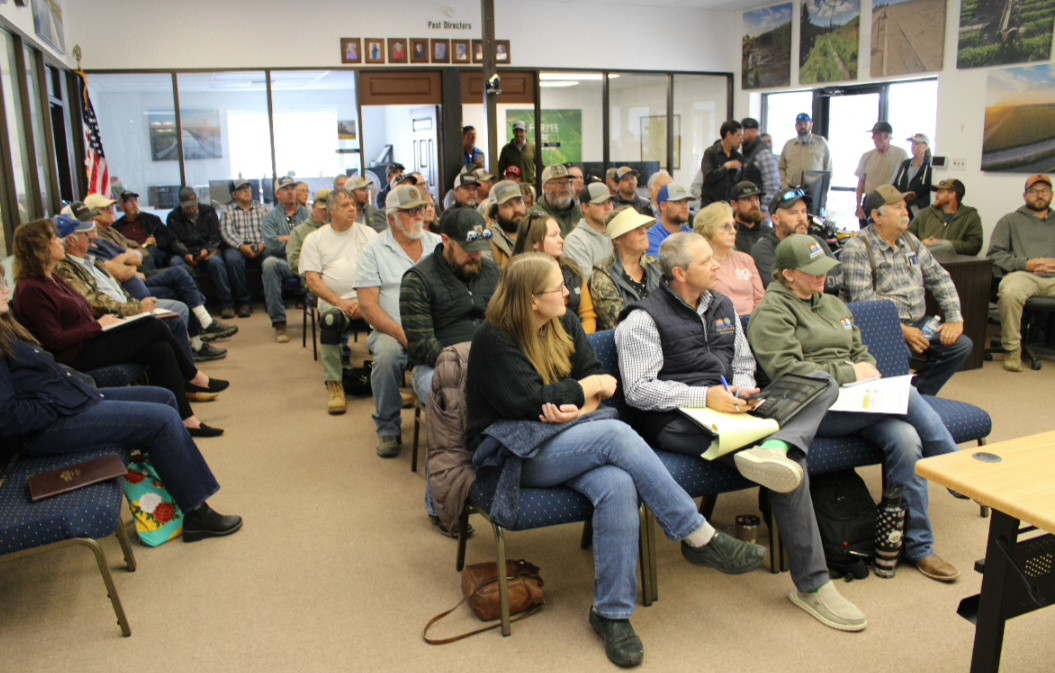
The Lower Arkansas Valley Water Conservancy District lobby was filled to capacity for this presentation, October 29, 2026.
The “18 Year Statute” prior to the 1969 Water Rights Determination and Administration Act (148-19-1): “That during said period of eighteen years or more immediately preceding institution of such action, the water official or officials who had, de facto or dejure, exercised jurisdiction in the water district in which the diversion works were located, have continuously recognized said decree as though it had been validly entered, and caused or permitted water of the stream from which said water right was adjudicated to be diverted in accordance with the terms of the decree whenever water was available therefrom.”
The Division of Water Resources reviewed current tabulation and administration, performing research on past administration, adjudication records, and diversion records to answer the following. What Division 2 water rights shown in DWR’s database are tabulated inconsistent with historical administration by water officials? Do state records support that those water rights enjoyed by 18 continuous years of diversions for beneficial use, based only on appropriation? Factors considered in this investigation are the administration number in the Hydrobase, past direction as indicated by historical water commissioner sheets relied on for administration, diversion records, and consistent records for at least 18 continuous years indicating administration based on appropriation date.
A tabulation change is proposed to match historic practice. Some rights have a long history of water commissioners directing use according to appropriation date, although the Admin number indicates a postponed priority. DWR reviewed diversion records to determine which rights have at least 18 years of continuous diversions allowed according to appropriation date, without postponement. Sixteen water rights matched these criteria: Joseph Dunn Ditch, Lake Creek Ditch, Colorado Gulch Ditch, Rock Creek Ditch, McDonald Ditch, Thompson & Derry Ditch, Cogan & Day Ditch, New Salida Ditch, Lake Henry twice, Kicking Bird Canal (Ft Lyon), Dye Reservoir (Holbrook), Fort Bent Canal, Amity Canal, John Martin Reservoir (Horse Creek), and John Martin Reservoir (Muddy Creek).
DWR plans to update the Admin numbers in the tabulation database to reflect only the appropriation date. Any tabulation change for these rights will not change the way DWR directs their water use, but it will correct the tabulation to match water administration. Tabulation would change according to this example: Lake Creek Ditch: current Admin number: 22888.10774. The first number reflects a previous adjudication date: August 31, 1912. The second number reflects the appropriation date: July 1, 1879. The proposed Admin number (no postponement) would be 10774.00000 which reflects the appropriation date and matches historic practice with no change in administration.
DRW will not change the tabulation unless documentation shows the right was lawfully enjoyed for a period of 18 years and administered according to the tabulation, which may include postponement as indicated by court decrees.
The overall intent of the proposed change in tabulation is to maintain historic practice of administration of the river in Division 2. Admin numbers are to reflect the reality of how water rights are administered and will be used when making a river call. Many questions have yet to be answered. Specific ditch questions can be directed to DNR_Div2_inf@state.co.us. The proposed tabulation revision can be accessed at the Division 2 webpage.
The tabulation changes are a proposal and not a final decision. Comments will be entertained on the revised tabulation. Some in attendance were skeptical that their comments to the Water Engineer concerning this proposal would have any effect or influence on the final decision.
# # #
Filed Under: Agriculture • Featured • Water
About the Author:


