4.25 million gallons of raw sewage taints Arkansas River after Pueblo city accident
Barbara Crimond | Aug 29, 2026 | Comments 0
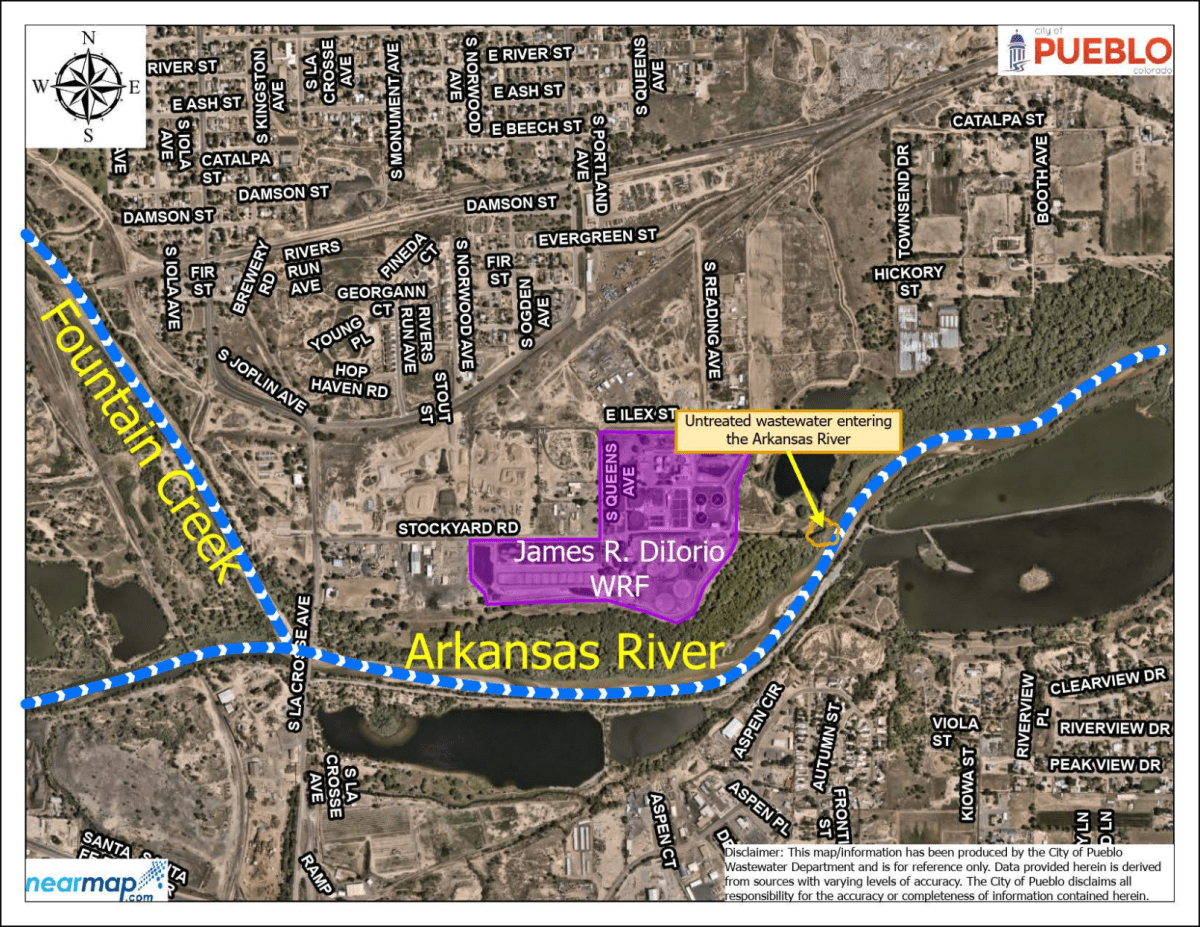
Untreated sewage flowed through a stormwater pipe and into the Arkansas River in Pueblo after a patch to a concrete sewer plant pipe failed. The spill caused public health officials to warn people not to recreate on the river as far east as Las Animas through Aug. 31, 2026. (City of Pueblo Wastewater Department)
A repaired waste pipe broke and dumped untreated sewage straight into the stream, prompting warnings from Avondale to Las Animas
A failed Pueblo wastewater pipe spewed 4.25 million gallons of raw sewage directly into the Arkansas River, prompting state health warnings to farmers and recreators as far east as Las Animas to avoid using or coming into contact with stream water.
Department of Agriculture officials are working with the melon and other produce farmers that make up the core of the Lower Arkansas Valley economy to find alternative sources and test their water while dangerous bacteria and other germs wash through southeastern Colorado.
Pueblo utility officials said a sewage pipe that was repaired with concrete inside a stormwater discharge pipe burst under pressure Wednesday, and was discovered and shut down Thursday. But the millions of gallons of untreated sewage escaped into the stormwater pipe, which discharges into the Arkansas River east of Interstate 25.
“Discharges of raw sewage into waterways contain harmful bacteria that present risks to human health. Produce growers who fall under the FDA’s Produce Safety Rule must ensure any water they use before, during, or after harvest is of adequate quality,” the state health and agriculture departments warned.
Pueblo County health officials collected water samples upstream and downstream of the spill. While samples taken upstream showed low levels of the harmful bacteria E. coli, levels downstream of the spill are “extremely high,” the Colorado Department of Public Health and Environment announced Friday night.
The department said people should not recreate in or use the river water until testing shows levels have returned to normal. Pets and livestock also should not use or drink from the water.
There is no evidence, at least so far, that the sewage spill has compromised public drinking water systems downstream, CDPHE said. Such systems were notified of the spill early enough to shut off their intakes. They also have other systems in place to prevent contamination.
People who use a private well or other private water supply and believe it may have been tainted should contact CDPHE’s Water Quality Control Division for guidance.
Lower Arkansas Valley water supply and water quality officials said they worry that the impacts of the sewage contamination could be exacerbated by the ongoing drought. When spills can’t be contained, “dilution is the solution” is a common public health mantra, but with extremely low water levels in many Colorado river systems, there are no surges of water for dilution.
“Our farmers take tremendous pride in producing safe, high-quality food. Fortunately, most of our produce growers have relied on groundwater this year, providing some protection from the spill,” said Jack Goble, general manager of the Lower Arkansas Valley Water Conservancy District. “For those who rely on surface water from the Arkansas River, this will present a challenge, and we’ll work closely with our farmers and agency partners to provide them the most accurate information available to help lessen the impact.”
The state agriculture department notified registered produce growers along the valley, and also warned the ranchers with property along the way who may use river water.
Pueblo’s Wastewater Department warned downstream communities to avoid water contact from the river through Aug. 31, including Avondale, Boone, Fowler, Manzanola, Rocky Ford, Swink, La Junta and Las Animas.
# # #
Filed Under: Agriculture • Environment • Featured • Health • Public Safety • Ranching • Recreation • Water
About the Author:


